|
The level of international cooperation activity achieved by BRI has been greatly expanded in recent years and its importance has increased, due to the upgrading of Japan's importance in the world and improvements in the level of science and technology.
BRI has a long history of international cooperative activities. For example, at the International Institute of Seismology and Earthquake Engineering, 1,664 participants from 99 developing countries have been accepted for training in seismology and earthquake engineering since 1962.
Investigation and technical cooperation on earthquake damage occurring in overseas countries have also been carried out many times from the Iranian Earthquake in 1962 to the Chile Earthquake in 2010.
In addition to above continuous cooperative activities, BRI has been involved with activities such as international collaborative research projects, as represented by the US-Japan Research on Large-Scale Seismic Resistance Tests, and technical assistance to developing countries through the Japan International Cooperation Agency (JICA).
|
|
| 2.Research Exchange-International Conferences |
| BRI has regularly participated in several international organizations such as CIB, RILEM, ISO, FORUM, IEA, ANCRiSST and IPRED.
The outlines of the activities are mentioned below.
|
(1) CIB (International Council for Research and Innovation Building and Construction)
|
This organization was established in 1953 with the support of United Nations, and it aims to encourage and facilitate international cooperation for building research, survey application, and information. Since the initial aim of this organization was the rehabilitation of Europe after World War?, the majority(more than half) of the members are from Europe. However, there is a movement for the CIB to play the role of the "United Nations of the Construction Industry", and the CIB has recently been trying to broaden its activities. By 2010, 500 organizations from various fields like research, education and production had joined this organization. And more than 50 Task Groups and Working Commissions are organized.
BRI is the national delegate for Japan and has been participating in the annual board meeting and the general meeting which is held every three years. Personnel from BRI have also been participating in various task groups and contributing to CIB activities.
CIB Domestic Council of Japan was established in February, 1975. BRI takes the leading role in those activities as well.
|
(2) RILEM (Reunion Internationals des Laboratories d'Essais et de
Recherches sur les Materiaux et les Constructions)
|
RILEM was established in 1947 to restart research exchange which was terminated due to World War?. Its international activity is now as large as that of the CIB. The number of members is more than 1200 in November 2009. There are 51 individual members, 5 associate member organizations and 2 special member organizations participating from Japan. BRI has been attending the annual general meeting as the national delegate. Also, personnel from BRI have been participating on various technical committees and contributing to the activities of RELEM.
|
(3) ISO (International Standards Organization)
|
ISO was established in 1947 to establish global standardization and to develop related activities in order to ease the international exchange of goods and services, and to encourage international cooperation for intellectual, scientific, and economic activities. The ISO has been setting standards for all kinds of fields apart from the electrical field.
BRI personnel have also been participating in such technical groups as TC92 (fire safety) and TC98 (fundamentals of building design).
|
(4) FORUM (International Forum for Collaborative Research on Fires)
|
The FORUM is an international organization established in 1988 for the purpose of promoting research. The FORUM is composed of research institutes from various countries that conduct research mainly on fire disasters. The Building Research Institute, which is one of the leading research institutes promoting fire disaster research, is also a member of the FORUM.
Since its inauguration, the FORUM has assembled annually, bringing together the principle researchers involved in fire research at various institutes. As we have witnessed the globalization of market and trade competition and the trend toward international standardization, the FORUM also used international cooperation to set forth a policy for promoting fire research. As a key figure in promoting fire research, BRI has participated in the FORUM every year.
|
(5) Other International Conferences and Surveys
|
IEA was established as the autonomous intergovernmental organization of developing oil-consuming counties in 1947 in the framework of the Organisation for Economic Co-operation and Development (OECD), proposed by the United States during the oil crisis. Its headquarters is located in Paris. IEA member countries are 28 including Japan.
The IEA Energy Conservation in Buildings and Community Systems (ECBCS) Program is mainly undertaken through a series of research projects (so-called 'Annexes').
BRI personnel have also been participating in several Annexes such as
Annex41: Whole Building Heat, Air and Moisture Response (MOIST-EN)
Annex43: Testing and Validation of Building Energy Simulation Tools
Annex44: Integrating Environmentally Responsive Elements in Buildings
Annex45: Energy-Efficient Future Electric Lighting for Buildings
|
(6) ANCRiSST (Asian-Pacific Network of Centers for Research in Smart Structures Technology)
|
ANCRiSST was established in 2002 by the institutes which study on smart structures technology in Asia-Pacific region. The aim of ANCRiSST is to research and development the innovative technologies of maintenance for the progress of structural performances.
The founding members are 5,
|Smart Structures Technology Laboratory (SSTL), University of Illinois, USA
|Smart Infrastructure Technology Center (SISTeC), Korea Advanced Institute of Science and Technology, KOREA
|Center for Intelligent High-Performance Structures (CIHPS), Hong Kong Polytechnic University, CHINA
|Smart Structures Research Center (SSRC), Advanced Industrial Science And Technology (AIST), Tsukuba, JAPAN
|Building Research Institute, (BRI), Tsukuba, JAPAN
And later, 15 more institutes joined as full members.
BRI personnel have been participating in various activities such as workshops and board meetings.
|
(7) IPRED (International Platform for Reducing Earthquake Disasters)
|
IPRED is the program which consists of research institutes related to earthquake disaster reduction from 9 countries including Japan. IPRED�fs missions are to construct the global network of research and training in the field of seismology and earthquake engineering, to create the database of earthquake disaster reduction, to propel the post-earthquake damage investigation systems and so on. International Institute of Seismology and Earthquake Engineering (IISEE) acts as �gCenter of Excellence�h of this program and counsels for construction of the network.
|
(8) Other International Conferences and Surveys
|
| Other than the activities mentioned above, BRI executives and staff members
have been participating in international trainings, collaborative researches,
technical cooperation and attending various international conferences. A total
of 1,577 people have traveled abroad from 1996 to 2014 including those who
were sent under the 5th Article of the Research Exchange Act. |
Fiscal year |
1996~2000 |
2001 |
2002 |
2003 |
2004 |
2005 |
2006 |
2007 |
2008 |
2009 |
2010 |
2011 |
2012 |
2013 |
2014 |
TOTAL |
Number of personnel |
637 |
76 |
80 |
76 |
68 |
52 |
76 |
62 |
71 |
76 |
75 |
47 |
70 |
48 |
63 |
1,577 |
|
| 3. Collaborative Research between Developed Nations
|
| |
| (1) UJNR (U.S.-Japan Cooperative Program in Natural Resources) Panel
on Wind and Seismic Effects |
| The first cooperative conference as a panel of UJNR was
held in Tokyo in 1969. Since then it has been held annually in Japan and
in the United States alternately. The aim of the conference is to exchange
opinions concerning the results from development research into the wind
and seismic resistance design opinions concerning the results from development
research into the wind and seismic resistance design of structures, exchange
results from surveys on problems in design standards, and to develop synthetic
measures and areas of technology to prevent loss of property and human
life due to strong winds, strong-motion earthquakes, tsunami, and high
tide. BRI has been presenting approximately 10 papers every year and many
personnel have attended the conferences. In add class="txt1"ition,
10 task groups have been working on individual themes under the joint
group. The following are some example research projects. |
U.S.-Japan Joint Research Projects on Large-Scale
Seismic Resistance (1979-present) |
This joint research is achieved under the UJNR Panel on
Wind Seismic Effects and focuses on the safety level of seismic resistance
in various structures. The following results are expected from these joint
research projects:
- Establishment of design methods to secure a higher level of safety
- Establishment of design methods to secure more effective cost performance
- Establishment of methods to evaluate seismic safety with higher
precision
- Establishment of test methods for achieving faithful reproductions
of earthquake behavior
- Reinforcement of competitiveness in the international market along
with the increase of overseas construction
- Establishment of the proper exchange of personnel and information
These joint research projects are carried out over a two to three year
period, depending on the type of structure, according to the following
yearly plan.
1977-79 Working Group for Planning
1979-81 Research on Reinforced Concrete Structures
1981-84 Research on Steel Structures
1984-89 Research on Masonry Structures
1989-93 Research on Precast Concrete Structures
1993-98 Research on Hybrid Structures
1998-2003 Smart Structure System |
|
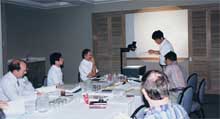
U.S-_Japan Cooperative Earthquake Research Program
on Composite and Hybrid structures,
Joint Thnical Committee Meeting. ec
|
(2) UJNR Panel on Fire Research and Safety
|
The first joint panel meeting as one of the panels of
UJNR was held in Washington, DC in 1976. It is held every 18 months, alternating
between Japan and the United States. The conference aims to encourage
the exchange of information and data in the areas of fire safety and science,
and promote cooperative research. The Director General of the BRI is the
Co Chairman of the Panel. The latest joint panel meeting was held at BRI
and National Research Institute of Fire and Disaster in May-June 1998.
|
U.S.-Japan Joint Research Projects on Fire Prevention |
Current research projects are aimed at developing models
of fire spreading in urban areas. The research includes a focus on tests
for peculiar phenomena in urban fires such as leaping and merging flames,
in order to gain a quantitative understanding of such phenomena, learn
more about the process of spreading fires, and develop models of that
process.
|
(3) France-Japan Technology Cooperation Agreement
|
| The following research is being conducted according to
this agreement. |
|
France-Japan Joint Research and Development on Materials
and Components (1995-present) |
Research on the microstructure and deterioration of building
materials is one of the projects being conducted under the France-Japan
Technology Cooperation Agreement and is aimed at improving the durability
of reinforced concrete components. More specifically, deterioration phenomena
are analyzed in the relationship between the microstructure, especially
the pore structure, and the physical substance transfer phenomena effected
by the pore structure, to obtain the basic data needed for improving durability.
To commemorate this project, an international workshop for evaluating
the heat and moisture properties of building components was held at CSTB,
France, in January 1995.
|
(4) Canada-Japan Science and Technology Cooperation Agreement
|
| The following research is being conducted according to
this Agreement. |
|
Canada-Japan Joint Research Project on Advanced Housing
Technology (1993-present) |
|
Varied research and development information regarding the construction
of future houses by applying advanced technology is exchanged between
both nations. Specific research themes are established according to
need, and the research is conducted jointly. The following are five
of the themes that have been established.
- Wall structures capable of preventing deterioration by humidity
- Energy-saving and fire prevention performance of thermal insulation
windows
- Indoor climate and energy consumption survey of houses
- Evaluation and standardization of ventilation systems in airtight
houses
- Construction and performance evaluation of advanced houses
The research goals include:
- the application of advanced technology to housing, and
- the establishment of planning and designing methods for such housing.
In add class="txt1"ition, Japan-Canada Housing R&D Workshop
has been held at least once every two years, and the results and future
plan are discussed in the workshop.
|
(5) EU-Japan Science and Technology Forum
|
| After the Great Hanshin Earthquake in January 1995, a
committee member of the EU Committee for Science and Technology visited
Japan, and an agreement for promoting collaborative research on seismic
resistant structures was concluded between the EU and Japan after a meeting
with the Minister of Construction. Based on this agreement, an expert
was dispatched to the Institute for Systems, Informatics, and Safety (ISIS)
in November 1995. A summary of the research themes to be undertaken and
the method of conducting collaborative research (such as information exchanges,
mutual dispatch of researchers, meetings for research planning, etc.)
were discussed and agreed upon at that time.
|
EU-Japan Joint Research Project on Seismic Resistance
(1997-present) |
|
The ISIS of the EU and the BRI concluded an agreement on research and
development cooperation for conducting full-scale structural tests in
March 1996. It is stated in the agreement that information exchange
on full-scale building structural tests, mutual dispatch of researchers,
and a feasible study of the subjects of research and development should
be actively promoted. Already experts in both institutes have visited
each other to exchange information.
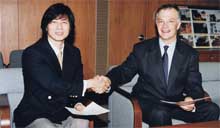 Signing the minutes at a joint conference to promote
cooperative research.
Signing the minutes at a joint conference to promote
cooperative research. The following six assignments are being undertaken in the collaborative
research.
- Assignment 1: Evaluation and mutual comparison of the earthquake
resistant performance of building structures designed by the existing
seismic resistance standards of the EU and Japan
- Assignment 2: Development and verification of new earthquake resistant
design methods based on performance-oriented concepts
- Assignment 3: Study of the effects on building structures caused
by impulsive earthquake motion occurring in the vicinity of the hypocenter,
and the long-cycle earthquake motion occurring on soft ground away
from the hypocenter
- Assignment 4: Establishment of the basic concept of baseline isolation
and earthquake control applied to building structures
- Assignment 5: Development and verification of the vulnerability
evaluation method and the rehabilitation and reinforcement method
for existing building structures
- Assignment 6: Development of full-scale test methods
|
(6) International Research Exchange
|
In add class="txt1"ition to the above joint
research, the following countries are international counterparts for scientific
and technological cooperation: UK, Italy, Sweden, Poland, Finland, Russia,
China, Australia, and Korea.
|
(7) Research Exchange \Study Abroad, Welcoming Foreign Researchers
and Visitors
|
- Study Abroad (As of March 1998)
BRI researchers have opportunities to study abroad supported by several
fellowship systems such as the Overseas Research Fellowship of the
Science and Technology Agency, and the invitation system from overseas
research organizations. The total number of researchers who have studied
abroad under one of these fellowship systems in the ten years since
1988, is as follows:
- Science and Technology Agency Long-term Overseas Research Fellowship:
5 persons (including nuclear research)
- Science and Technology Agency Medium-term Overseas Research Fellowship:
4 persons
- Science and Technology Agency Part Guarantee: 9 persons
- Invitation by Overseas Research Organizations: 6 persons (excluding
the Science and Technology Agency Part Guarantee)
- Acceptance of Overseas Researchers
The total number of foreign researchers invited and funded by the
Science and Technology Agency Fellowship for Foreign Researchers,
and by Special Research on the Expense of the Science and Technology
Agency of the same agency, as well as those funded by their own country's
government (excluding the JICA group and individual participants),
exceeds 119 in the 10 years from 1988 to 1997.
- Visitors
The total number of visitors from overseas countries from 1996 to 2014 was 3,514 as the following chart.
|
| Fiscal year |
96-00 |
01 |
02 |
03 |
04 |
05 |
06 |
07 |
08 |
09 |
10 |
11 |
12 |
13 |
14 |
Total |
| Number of Groups |
157 |
19 |
27 |
21 |
18 |
23 |
19 |
26 |
20 |
20 |
30 |
29 |
16 |
18 |
16 |
459 |
| Number of Visitors |
894 |
162 |
262 |
174 |
132 |
145 |
176 |
282 |
237 |
170 |
333 |
244 |
117 |
111 |
75 |
3,514 |
|
|

 Other International Cooperation